
Translating IFRS Financial Statements into Arabic: A Practical Guide

When a listed company publishes its financial statements in both Arabic and English, the two versions often sit side by side, and analysts, auditors and regulators can compare them. A caption that drifts between versions, a negative figure that loses its brackets, or a note reference that points to the wrong page is visible to everyone who compares them.
This guide to IFRS financial statements Arabic translation is for finance, investor relations and reporting teams that commission English-to-Arabic or Arabic-to-English translation of annual statements, interim reports and the financial sections of annual reports. It covers the decisions to make before translation starts, the terminology that varies by market, how numbers behave in a right-to-left layout, and a checklist for reviewing the result.
1. Know which version the regulator treats as official
Before choosing a single term, confirm the language status of the document you are producing.
In Saudi Arabia, the Capital Market Authority (CMA) decided in October 2020 that issuers with securities listed on the Main Market must make notifications to the Exchange and disclosures to the public in both Arabic and English, starting from 1 January 2021 (with a later start date for exchange-traded funds). The CMA’s English versions of its own regulations also carry a note that the official text is in Arabic and that the English document is an unofficial translation.
In the UAE, the Abu Dhabi Securities Exchange asked listed companies in September 2024 to submit their third-quarter financial report in both Arabic and English through its electronic disclosure services.
In practice, the Arabic text in these markets is not a courtesy copy. Treat both versions as publishable documents from day one, and ask your legal or investor relations team and your auditor which rules apply to your filing and which version governs.
2. Settle the terminology system before translation starts
Arabic accounting terminology is not uniform across the region. The same IFRS concept can appear under different, equally correct Arabic terms depending on the market, the regulator and the audit firm. The IFRS Foundation publishes Arabic translations of IFRS Accounting Standards, and in Saudi Arabia the Saudi Organization for Chartered and Professional Accountants (SOCPA) handles endorsement of IFRS, including translation of new standards and amendments. Egypt reports under Egyptian Accounting Standards, which have their own established Arabic wording.
A few common examples of variation:
| English (IFRS) | Often seen in Gulf filings (esp. banks) | Often seen in Egyptian filings |
|---|---|---|
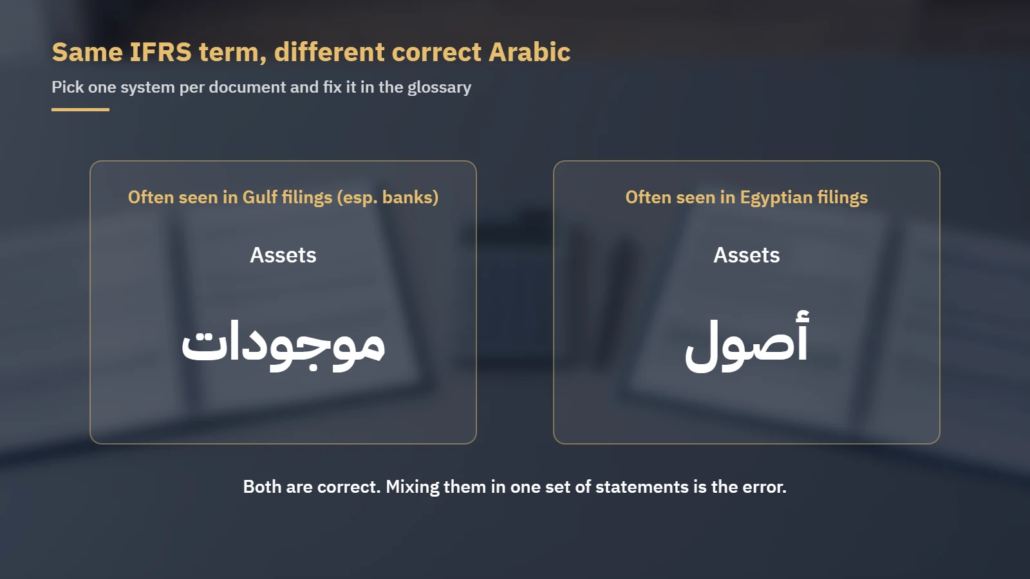
| Assets | موجودات | أصول |
| Liabilities | مطلوبات | التزامات |
| Impairment | الانخفاض في القيمة | اضمحلال القيمة |
| Retained earnings | الأرباح المبقاة | الأرباح المرحلة |
None of these is wrong. The mistake is mixing them in one document, so that the statement of financial position says موجودات and a note three pages later says أصول. Decide on one system, usually the one in the company’s prior-year Arabic statements or the terminology the auditor uses, and put it in a glossary before the first page is translated.
3. Get the statement titles and fixed phrases right
The primary statements have widely used Arabic titles. Wording still varies by market (UAE filings, for example, often use بيان rather than قائمة, as in بيان المركز المالي, and Egyptian filings use titles such as قائمة الدخل), so follow the company’s prior filings. Common renderings are:
- Statement of financial position: قائمة المركز المالي
- Statement of profit or loss and other comprehensive income: قائمة الربح أو الخسارة والدخل الشامل الآخر
- Statement of changes in equity: قائمة التغيرات في حقوق الملكية
- Statement of cash flows: قائمة التدفقات النقدية
- Notes to the financial statements: إيضاحات حول القوائم المالية
Other recurring terms deserve the same discipline: fair value (القيمة العادلة), expected credit losses (خسائر الائتمان المتوقعة), non-controlling interests (الحصص غير المسيطرة), going concern (مبدأ الاستمرارية), and provisions (مخصصات), which must not be confused with reserves (احتياطيات). Revenue (إيرادات) and income (دخل) also need to stay distinct, because IFRS uses them differently.
The basis-of-preparation paragraph is another fixed phrase. Saudi entities typically state compliance with IFRS Accounting Standards as endorsed in the Kingdom of Saudi Arabia and other standards and pronouncements endorsed by SOCPA. Wording like this should be reproduced exactly as the auditor and prior filings use it, not paraphrased.
4. Handle numbers, signs and layout in a right-to-left document
Many of the errors that readers notice in Arabic financial statements are layout errors, not language errors. In an Arabic document, the table reads from right to left: the caption column sits on the right, followed by the note reference, then the current and comparative periods. The figures themselves still read left to right.
Points to agree before layout begins:
- Column order: current period and comparative period must stay in the same logical order as the source, and the headers must still match their columns after mirroring.
- Negative figures: brackets such as (1,250) must survive the move to RTL. In some tools the brackets can flip or detach from the number.
- Digits: decide between Western digits (0–9) and Arabic-Indic digits (٠–٩), and use one style throughout, including in notes and headers.
- Units and currency: a heading such as “SAR ‘000” needs an agreed Arabic equivalent (for example, بآلاف الريالات السعودية) used consistently on every page.
- Note references and page cross-references: these must be checked after layout, since page numbers often change between the English and Arabic files.
- Dates: agree whether Gregorian dates appear alone or alongside Hijri dates, and follow the format of prior filings.
Because the figures are the part most likely to be affected by reformatting, a numbers check against the source should be a separate pass after desktop publishing, not something assumed from the translation stage.
5. Islamic finance and banking terminology
Banks, finance companies and insurers in the region often report Islamic financing products, and their terms should normally be kept as established Arabic terms rather than paraphrased: murabaha (مرابحة), ijara (إجارة), mudaraba (مضاربة), musharaka (مشاركة), wakala (وكالة) and sukuk (صكوك). Translating sukuk into Arabic as “Islamic bonds” (سندات إسلامية) blurs a distinction that the issuer’s disclosures are usually careful to make.
Wording choices also reflect how an institution describes its income. Some Saudi banks, for example, report “special commission income” (دخل العمولات الخاصة) in their English statements rather than “interest income”. The translator’s job is to follow the institution’s own terminology, not to substitute a more familiar term.
Institutions that report under AAOIFI standards have a further reference point: AAOIFI has issued recent standards, such as FAS 39 and FAS 41, officially in Arabic, so its Arabic terminology is a natural starting point for those clients.
6. Keep the annual report and the financial statements consistent
The narrative sections of an annual report, such as the chairman’s statement, board report and management discussion, often quote figures and terms from the financial statements. When different teams translate these sections at different times, the same metric can end up with two Arabic names. Running the whole report against one glossary, and keeping the same translators on the account from year to year, reduces this risk and makes the next year’s report faster to prepare.
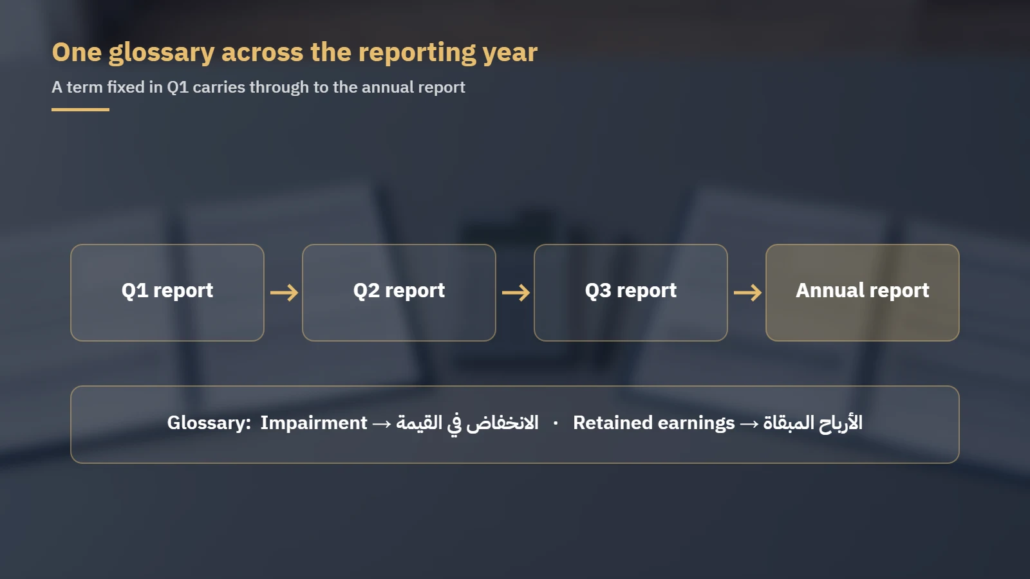
The same applies to interim statements. A term fixed in the Q1 report should carry through Q2, Q3 and the annual statements.
7. A review checklist for translated financial statements
Before the Arabic or English version goes to the auditor, investor relations or the board, check:
- Every primary statement title matches the agreed Arabic or English wording.
- One terminology system is used throughout (for example, موجودات or أصول, not both).
- All figures, totals and subtotals match the source, including comparatives.
- Negative figures keep their brackets, and no signs have moved.
- Note numbers in the statements point to the correct notes.
- Units and currency headings are identical on every page.
- Islamic finance terms follow the institution’s own usage.
- Fixed phrases (basis of preparation, auditor references) match prior filings.
- The narrative sections of the annual report use the same terms as the statements.
Working with Locstars
Locstars’ financial translation team works with native-speaker translators who specialize in the subject matter, and builds a term glossary for each client so that the same terms carry through every quarterly and annual report. Clients own their translation memory and receive reduced rates on matched content, and we keep the same team on an account. Our DTP team handles RTL layout for financial tables and delivers files in the format you send. We work under your NDA, delete files on request, and can translate a sample from your own document before a large project. Editing and proofreading by a second linguist is available as a separate, optional step. Request a quote and you will receive it within one business day.
This article covers translation and localization considerations only. It is not financial, accounting, legal or regulatory advice. Disclosure rules change; confirm current requirements and the governing language of any filing with your legal, compliance and investor relations teams and your auditor.
About the author: The Locstars financial translation team is made up of native-speaker translators who specialize in the subject matter, supported by a DTP team that handles RTL layouts. The team works between Arabic and English, Chinese, French, Spanish, German, Turkish, Russian, Hindi, Japanese and Korean.

