
Arabic Transcreation: MSA or Dialect for Gulf and Egypt Campaigns
A campaign line that works in English rarely survives word-for-word translation into Arabic: wordplay collapses, calls to action sound stiff, and the tone can land wrong. Transcreation is the process of rewriting the message so it does the same job for an Arabic-speaking audience: same intent, same brand voice, new words.
This guide is for in-house marketing, brand and e-commerce teams preparing Arabic versions of taglines, ads, social posts and product pages for the Gulf and Egypt. It covers which variety of Arabic to write in, the brief, format constraints and pre-launch checks.
1. Transcreation vs translation: what actually changes
Translation keeps the meaning of each sentence. Transcreation keeps the effect of the message and may change the words, imagery and rhythm. In practice, transcreation is the right approach for headlines, taglines, slogans, calls to action, social captions and video scripts. Specifications, terms of sale and legal footers still need accurate translation.
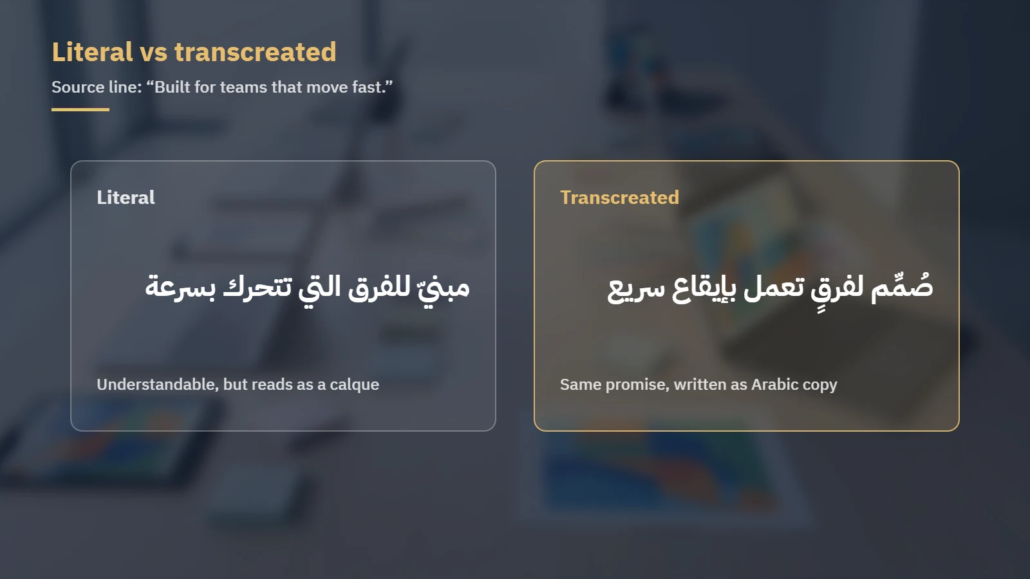
A simple example shows why. An English SaaS headline reads “Built for teams that move fast.” A literal rendering such as «مبنيّ للفرق التي تتحرك بسرعة» is understandable but reads as a calque: “built” and “move” are carried over from English and the line has no energy. A transcreated option such as «صُمِّم لفرقٍ تعمل بإيقاع سريع» (“designed for teams that work at a fast pace”) keeps the promise and sounds like it was written in Arabic.
Idioms are the clearest case. “It’s a piece of cake” cannot become «قطعة كيك». In Modern Standard Arabic the idea becomes «الأمر في غاية السهولة»; in Egyptian colloquial copy, a writer might use the familiar expression «زي شرب المية» (“like drinking water”).
2. Choose the register: MSA, Gulf or Egyptian
Arabic marketing copy is written in Modern Standard Arabic (MSA, فصحى) or a spoken dialect. MSA is understood across the Arab world and is the safe default for formal, long-lived or pan-regional content. Dialect creates closeness and is common in social media, video and influencer-style content, but it signals one market and can feel out of place elsewhere.
The same call to action shows the difference:
| English | MSA | Gulf (social) | Egyptian (social) |
|---|---|---|---|
| Shop now | تسوّق الآن | تسوّق الحين | اشتري دلوقتي |
| Don’t miss out | لا تفوّت الفرصة | لا يفوتك العرض | متفوّتش الفرصة |
A practical rule of thumb for B2B and brand teams:
- Use MSA for websites, product pages, packaging, press material, B2B campaigns and anything that runs in several countries.
- Consider dialect for short social posts, video scripts and voice-over where a conversational tone is the point, and only when the campaign targets one market.
- Avoid unplanned register mixing inside one asset: an MSA headline with an Egyptian call to action looks inconsistent unless the brand’s style guide sets it as a deliberate choice.
- Record the decision in the brief so every writer and reviewer works to the same register.
If a video or audio ad is part of the campaign, the register decision extends to casting: “Gulf” covers several distinct dialects, so a Saudi or Emirati script needs a voice actor who speaks that specific dialect naturally, and the same applies to Egyptian scripts.
3. Write a transcreation brief the linguist can use
Many transcreation problems start with a thin brief. A useful brief answers these questions:
- Objective: what the asset must achieve (awareness, sign-ups, sales, event registrations).
- Audience and market: country, sector, decision-maker or end user, B2B or B2C.
- Register: MSA or a named dialect, and how formal.
- Brand voice: three or four adjectives, plus examples of existing Arabic copy the brand likes or dislikes.
- Fixed elements: brand name spelling in Arabic or Latin script, product names that stay in English, trademarked terms, legal lines that must not change.
- Constraints: character limits, layout, image or video the text sits on, deadline.
- Keywords: the Arabic search terms the page or ad should target, confirmed by keyword research rather than by translating English keywords.
- Approval: who in-market signs off and what “approved” means.
For taglines, many teams ask for several options, each with a short English back-translation, so non-Arabic-speaking managers can take part in the choice.
4. Fit the format: ads, social and e-commerce
Write transcreated lines to length rather than trimming them afterwards. In Google Ads responsive search ads, headlines allow up to 30 characters and descriptions up to 90. Arabic and English versions of a line rarely match in length, so check each field.
- Search ads: write Arabic headlines from Arabic keyword research. A literal translation of an English keyword may be grammatical and still not be what buyers type.
- Social: hashtags cannot contain spaces, so multi-word Arabic hashtags are joined with underscores, as in #رمضان_مبارك. Check how mixed Arabic and Latin text (brand names, URLs, @handles) displays in right-to-left posts.
- E-commerce product pages: keep product titles, attribute names and size or colour values consistent across the catalogue with a term glossary; transcreate the marketing description, but translate specifications accurately.
- Visuals: text in images, banners and videos must be re-laid out right to left, and arrows or “before/after” sequences usually mirrored.
5. Numbers, currency and gendered forms
Agree these points in a style guide before production starts:
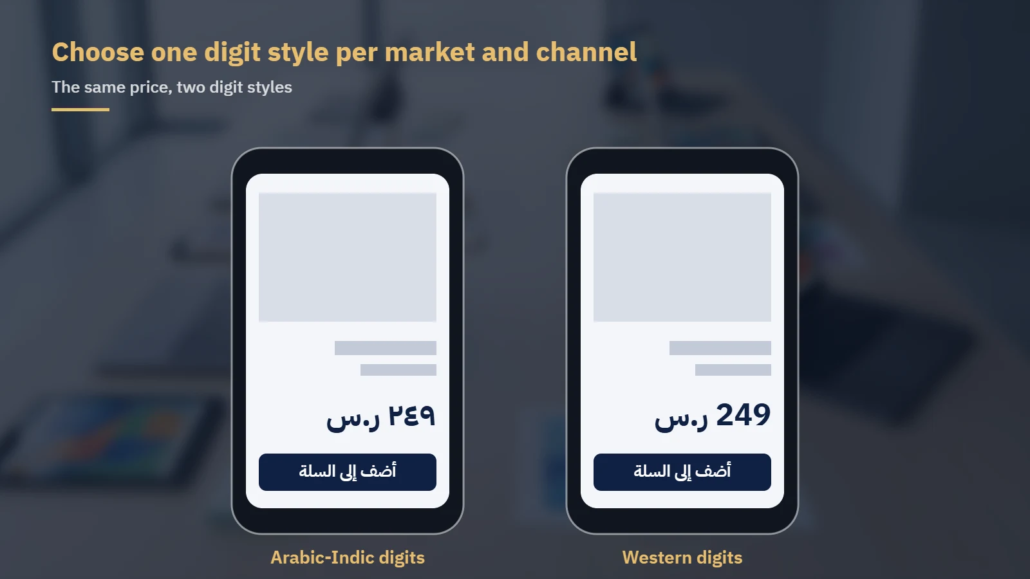
- Digits: Arabic copy can use Western digits (0–9) or Arabic-Indic digits (٠–٩). Choose one per market and channel and apply it consistently, including in prices and dates.
- Currency: the common Arabic abbreviations are ر.س (Saudi riyal), د.إ (UAE dirham) and ج.م (Egyptian pound). Saudi Arabia approved an official riyal symbol in February 2025, and it was encoded in Unicode 17.0 as U+20C1. Font support is still uneven, so test rendering on your site, app and ad platforms before using it.
- Gender and number: Arabic imperatives change with the audience: «سجّل اليوم» (masculine singular), «سجّلي اليوم» (feminine singular) and «سجّلوا اليوم» (plural). Decide whether the brand addresses readers in the singular or the plural and keep it consistent.
6. Ramadan and Eid campaigns: timing and tone
Ramadan follows the Islamic lunar calendar, which runs about 354 days, so the month starts roughly 11 days earlier each Gregorian year, and its exact start and end traditionally depend on sighting the new moon. For campaign planning, that means Arabic assets for Ramadan and Eid al-Fitr should be approved well before the expected date, with a plan for a one-day shift.
On tone, the season calls for warmth and generosity rather than hard selling. Standard greetings such as «رمضان مبارك», «كل عام وأنتم بخير» and «عيد مبارك» should be used correctly and not rewritten as puns. Avoid showing eating or drinking in daytime posts during Ramadan, and plan post timing around iftar and suhoor.
7. Pre-launch review checklist
Before any Arabic campaign goes live, check:
- The register matches the brief and is consistent inside every asset.
- Brand, product and trademark names follow the agreed Arabic or Latin spelling.
- Each headline and description fits its field limit in the actual platform, not only in a spreadsheet.
- Keywords come from Arabic keyword research and appear naturally in the copy.
- Numbers, prices, currency and dates follow the style guide.
- Mixed Arabic and Latin text displays correctly right to left, including punctuation.
- Images, banners and videos have been re-laid out, and text in visuals has been localized.
- Claims in the Arabic copy match what the English copy says, with nothing added or softened.
- A native Arabic reviewer has read the final assets in context: the live page, the ad preview or the rendered video.
Working with Locstars
Locstars is an Arabic translation and localization company. For marketing translation, we work with native-speaker, subject-specialist translators, build a consistent term glossary for your brand, and keep the same team on your account. For web and marketing localization we can carry out Arabic SEO keyword research, our DTP team handles right-to-left layout, and our in-house multimedia team provides Arabic voice-over with voice actors in different Arabic dialects. You own the translation memory, with reduced rates for TM matches, and editing and proofreading by a second linguist are available as a separate, optional step. We work under your NDA and can start with a sample translation from your own copy before a larger campaign. To discuss a project, request a quote; you will receive a quote within one business day.
Advertising, consumer-protection and pricing rules differ by country. This article covers translation and localization considerations only; confirm regulatory requirements for your campaign with your own legal or regulatory team.
About the author: The Locstars marketing translation team is made up of native-speaker, subject-specialist translators who adapt campaigns, ad copy, social content and product pages into Arabic, working with the company’s DTP team on right-to-left layout and its in-house multimedia team on Arabic voice-over.

