
PCT National Phase Arabic Translation: Saudi Arabia, Egypt, GCC
When a PCT application is headed for Saudi Arabia, Egypt or the Gulf states, the Arabic translation is a substantial part of the national phase work. It is also a part your patent attorney will review closely, because at offices that work in Arabic, such as SAIP and the Egyptian Patent Office, the Arabic claims are the text the examiner reads. This guide is written for in-house IP teams, patent paralegals and R&D managers who coordinate that work. It covers what the translation includes, how to plan it against the national phase time limit, and where Arabic claim language needs deliberate choices.
Procedural points below come from the PCT Applicant’s Guide published by WIPO (sources listed at the end). Requirements change, so confirm every deadline and filing requirement with your patent attorney or local agent before you rely on it.
1. What a PCT national phase Arabic translation covers
According to the national chapters of the PCT Applicant’s Guide for Saudi Arabia (Saudi Authority for Intellectual Property, SAIP) and Egypt, the translation for national phase entry is into Arabic and covers more than the description and claims. For entry under PCT Article 22, both chapters list:
- The description
- The claims, and if they were amended, both as originally filed and as amended, together with any statement under PCT Article 19
- Any text matter of the drawings
- The abstract
For entry under Article 39(1), after international preliminary examination, both chapters ask for the same parts, and where any part was amended, both the original and the version amended by the annexes to the international preliminary examination report.
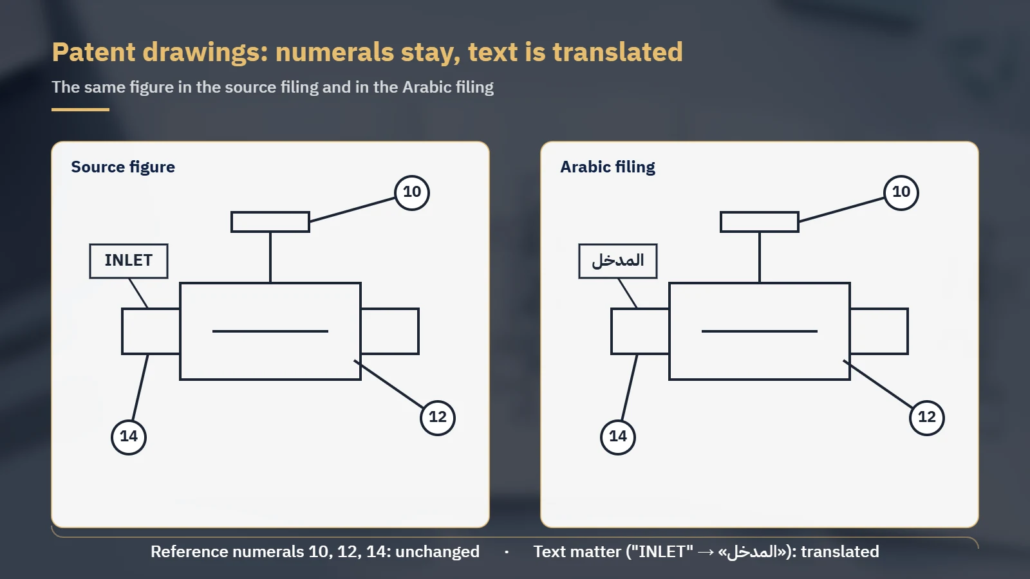
Two items are easy to miss. The first is the Article 19 amendment set and statement. If claims were amended after the international search, you may need two Arabic claim sets that must read consistently with each other. The second is text in the drawings: labels, flowchart boxes, axis titles and table headings inside figures. Reference numerals stay as they are; words around them get translated and placed back into the figure, or as your agent instructs.
| Part of the application | What to translate | Common pitfall |
|---|---|---|
| Description | Full text, including headings and tables | Tables pasted as images and never translated |
| Claims (as filed) | Every claim, keeping numbering and dependencies | Dependent claims translated out of order |
| Claims (as amended) and Article 19 statement | Amended claim set plus the statement, where these exist | Only one set translated when two were needed |
| Drawings | Any text matter inside the figures | Labels left in the source language |
| Abstract | The abstract text | Abstract wording drifting from claim terminology |
2. Planning backwards from the 30-month date
WIPO’s table of national phase time limits lists 30 months from the priority date, under both Chapter I and Chapter II, for Saudi Arabia, Egypt, the United Arab Emirates, Qatar, Oman, Bahrain and Kuwait. The Saudi and Egyptian chapters state that the Arabic translation is to be furnished within that time limit.
Your attorney needs time to review the Arabic claims and prepare the filing, so the translation deadline you give your language provider should sit well before the national phase date. A workable sequence:
- Your attorney confirms the national phase date and which offices you are entering.
- You send the final source files: the published application, any amended claims and Article 19 statement, and editable drawing files if you have them.
- The translation team builds a term glossary from the claims first, then translates the claims, then the description, drawings and abstract.
- Your attorney reviews the Arabic claims and flags any term they want changed.
- Changes are applied across all parts of the translation so the claims and description keep matching.
3. The GCC: one Arabic master, several filings
The GCC Patent Office stopped accepting new GCC patent applications on 6 January 2021. Each GCC state is individually a PCT member, which is why WIPO’s time limits table lists the six states separately rather than a regional GCC office. Bahrain, Kuwait and Qatar have referred national applications to the GCC Patent Office for examination since 2023 (Bahrain and Kuwait from 1 January, Qatar from 1 July), with grant decisions staying with the national offices.
For translation, this usually means one invention, several national filings. A single, reviewed Arabic master translation, reused wherever it fits, keeps terminology identical across offices. It also means one round of attorney comments can be carried into each filing. Language requirements are not identical across Gulf offices: WIPO’s chapters for Bahrain and the UAE, for example, list English as well as Arabic. Check each national chapter with your agent before assuming the same Arabic text serves every filing.
4. Arabic claim language: choices that affect scope
Arabic patent practice refers to claims as عناصر الحماية. The translator’s job is to carry the scope of each English claim into Arabic without widening or narrowing it. A few recurring decisions:
| English claim term | Typical Arabic rendering | Why it matters |
|---|---|---|
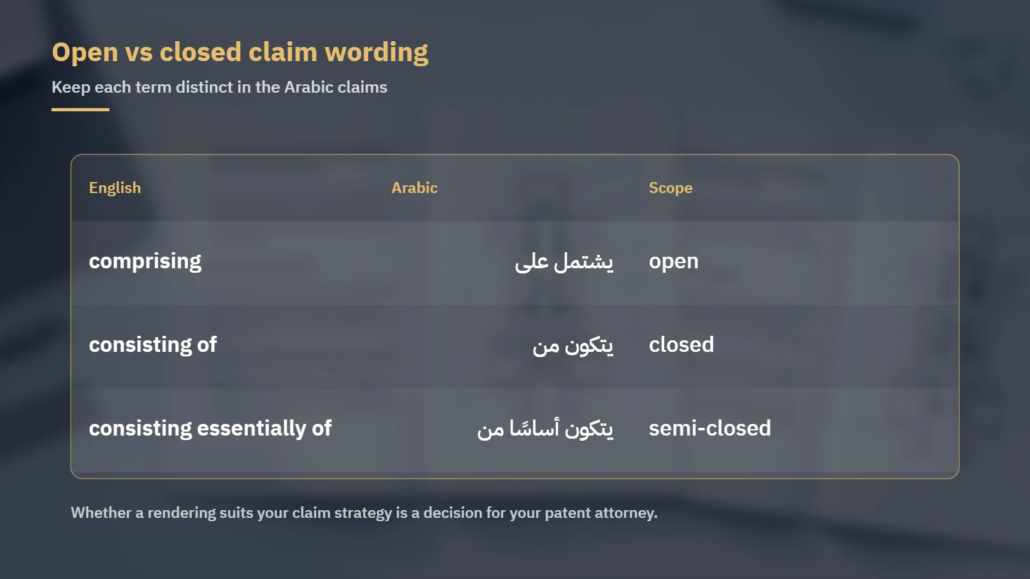
| comprising | يشتمل على | Open wording: other elements are not excluded |
| consisting of | يتكون من | Closed wording: should not be rendered like “comprising” |
| consisting essentially of | يتكون أساسًا من | Keep distinct from both terms above |
| wherein | حيث | Introduces a limitation; should attach to the correct element |
| characterized in that | يتميز بأن | Marks the characterizing part of the claim |
| at least one | واحد على الأقل | Should not collapse into a singular noun |
| according to claim 1 | وفقًا لعنصر الحماية 1 | Dependency references must match the claim numbering |
Antecedent basis needs the same care. In English, “a valve” becomes “the valve” or “said valve”. In Arabic, the first mention is indefinite (صمام) and later mentions use the definite article, often with المذكور for “said” (الصمام المذكور). If the Arabic first mention is already definite, an examiner reading the Arabic may see a missing antecedent.
Relative terms such as “substantially”, “about” and “approximately” also need one fixed rendering each, recorded in the glossary. A term that moves between two Arabic equivalents across the claims and description can suggest two different meanings. Whether a given rendering is acceptable for your claim strategy is a decision for your patent attorney. The translator’s role is to translate consistently and to flag any source wording that is ambiguous.
5. Description, drawings and abstract
The description supports the claims, so every claimed term should appear in the description in the same Arabic form. Other points to check:
- Scientific terms and chemical nomenclature: the Saudi national chapter asks for scientific terms to appear in the original language together with the Arabic translation when first used, for foreign abbreviations to be written out in full in Arabic and English when first used, and for chemical formulas and structural figures to use Latin letters following the IUPAC system. Confirm with your agent how to apply this in each filing.
- Numbers and units: decide early whether the Arabic uses Western digits (1, 2, 3) or Arabic-Indic digits (١، ٢، ٣), and apply that choice throughout, including tables and drawings.
- Drawings: Arabic text runs right to left, and labels often need more or less space than the English. Recreating the figure text in an editable file avoids handwritten corrections or pasted overlays.
6. A pre-handoff checklist for IP teams
- National phase date and target offices confirmed by your attorney
- Final published application and, where they exist, amended claims and Article 19 statement
- Editable drawing files where available, otherwise high-resolution images
- Any existing glossary or earlier Arabic translations for related family members
- Agreed digit style and any formatting required by your local agent
- Internal deadline for the Arabic draft, set to leave your attorney review time
Working with Locstars
Locstars is an Arabic translation and localization company. We work between Arabic and ten languages: English, Chinese, French, Spanish, German, Turkish, Russian, Hindi, Japanese and Korean. Our patent translation work is done by native-speaker translators who specialize in the subject matter. We keep a consistent term glossary for each patent family and keep the same team on your account, so later filings use the same Arabic terminology. Our DTP team recreates drawings and their text in right-to-left layouts, and we deliver files in the format you send. You own the translation memory, with reduced rates for matches, and we work under your own NDA and delete files on request. Editing and proofreading by a second linguist is available as a separate, optional step. For a large family, we can translate a sample from your own document first. Request a quote and you will receive it within one business day.
This article gives general information about translation for PCT national phase filings and is not legal advice. Deadlines, filing requirements and claim wording decisions belong to your patent attorney or registered local agent, who should confirm the current requirements of each office.
About the author: The Locstars Patent Translation Team is made up of native-speaker translators who specialize in technical and scientific subject matter. The team maintains client-specific term glossaries, works with a DTP team that recreates patent drawings in Arabic, and translates between Arabic and ten languages.

