
Arabic Labeling for Saudi Arabia: Translating Labels, PILs and IFUs

Labeling can come late in a Saudi submission, and it raises specific language questions: which carton particulars need Arabic, whether the leaflet must be bilingual, and what “Arabic” means for a device trade name. For Arabic labeling requirements in Saudi Arabia, the answers sit in a small set of Saudi Food and Drug Authority (SFDA) documents. This guide points labeling and regulatory teams to the relevant passages and covers the translation and artwork issues that follow. What your product needs remains a decision for your regulatory affairs team.
1. Start from the SFDA documents, not from the old artwork
Three SFDA documents cover most of the language questions for medicines and medical devices:
- Guidance for Presenting the Labeling Information, SPC and PIL (DS-G-094, version 3.3): the labeling particulars for medicines that need an Arabic translation.
- Templates for Labelling Information, SPC and PIL (DS-G-054, version 1.3): the section structure for the SPC and the PIL, with an English and an Arabic PIL template.
- Requirements for Medical Devices Marketing Authorization (MDS-REQ 1): the Essential Principles, including the language of information supplied with devices for lay persons.
If you are adapting artwork from another market, check it against the current SFDA documents before translation starts. SFDA documents are revised, so confirm the current version on the SFDA website and build the translation brief around it.
2. Medicine labels: which particulars need Arabic
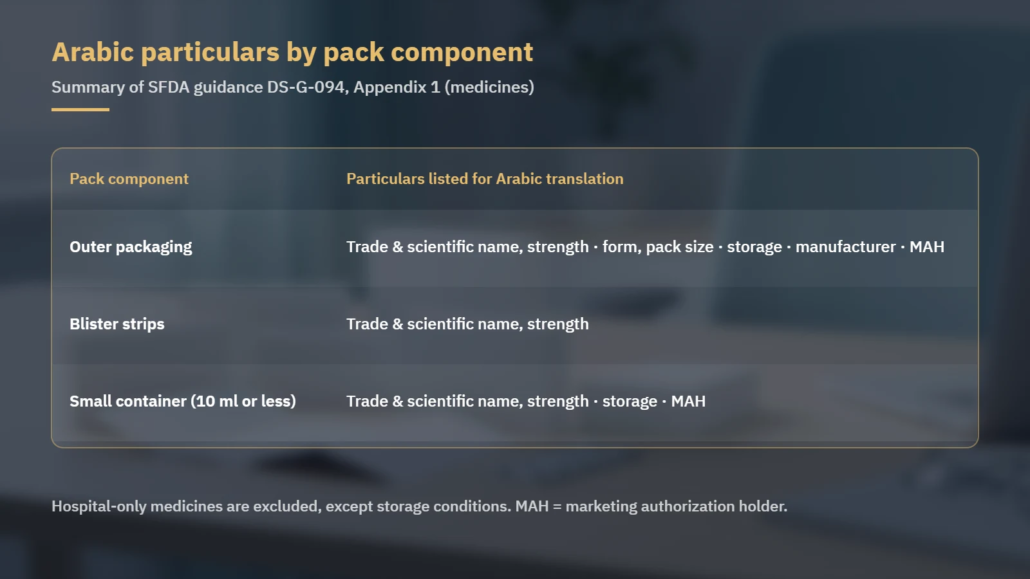
The labeling guidance (DS-G-094) states that the applicant must provide an Arabic translation for some labeling information, and lists them in its Appendix 1. In summary:
| Pack component | Particulars listed for Arabic translation |
|---|---|
| Outer packaging | Trade and scientific name and strength; pharmaceutical form and pack size; storage conditions; manufacturer; marketing authorization holder |
| Blister strips | Trade and scientific name and strength |
| Small immediate packaging (10 ml or less) | Trade and scientific name and strength; storage conditions; marketing authorization holder |
The appendix heading says this does not apply to medicines used only in hospitals. A footnote then makes an exception: storage conditions still need Arabic for hospital-only medicines.
Agree the Arabic trade name once and add it to the glossary before any artwork is touched. Storage statements also drift easily. “Store below 25°C” can become يُحفظ في درجة حرارة أقل من 25 درجة مئوية on the carton and a slightly different wording in the leaflet unless both come from one approved string.
3. The PIL: bilingual, and built on the SFDA template
The SFDA’s e-labelling page states that the SFDA requires the Patient Information Leaflet (PIL) to be in both English and Arabic. The template document (DS-G-054) sets the language as “SPC: English only, PIL: Arabic and English”, and it includes an Arabic PIL template alongside the English one.
The Arabic PIL follows the SFDA section structure, so translate into the Arabic template rather than rearranging your own layout afterwards. The Arabic headings and standard statements come from the template, not from the translator. For example:
| English template text | Arabic template text |
|---|---|
| Possible side effects | الأعراض الجانبية المحتملة |
| Keep this medicine out of the sight and reach of children | لا تترك الأدوية في متناول الأطفال |
A translator without the template may produce a more literal second sentence that is correct Arabic but does not match the template. Give translators the template as reference material and mark template strings as fixed in the glossary.
Register is the other issue. The PIL is written for patients, so dosing instructions should be clear and direct. “Take one tablet twice a day” becomes تناول قرصًا واحدًا مرتين يوميًا, not the technical phrasing used in texts written for healthcare professionals. Section headings, adverse-reaction terms and the trade name still need to be consistent across the carton and the leaflet.
4. Medical devices: information for lay users
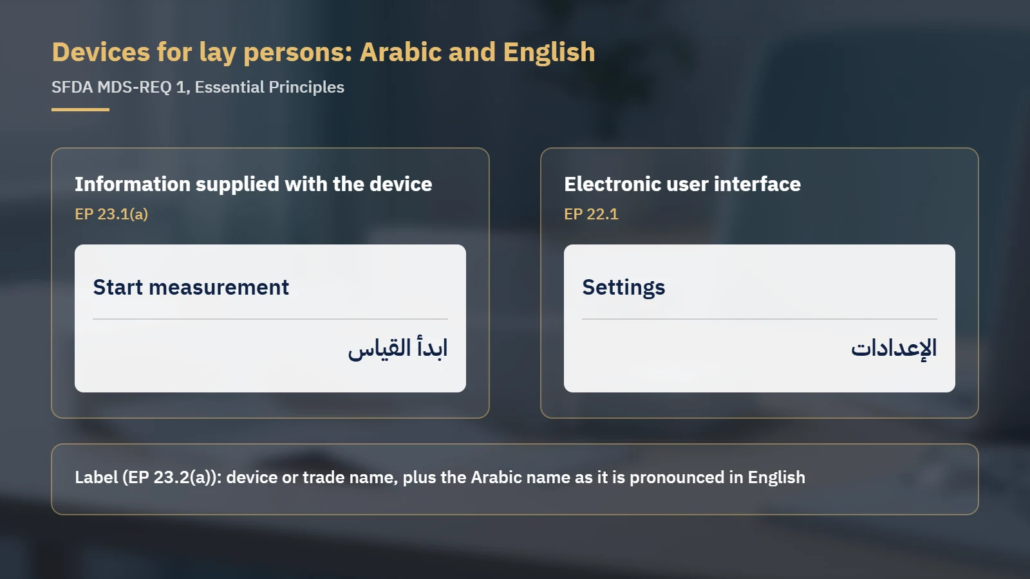
For medical devices, MDS-REQ 1 contains the Arabic requirements in the Essential Principles. For non-IVD devices, Essential Principle 23.1(a) states that “Information supplied by the manufacturer for devices for use by lay persons shall be in both the Arabic and English languages.” Essential Principle 22.1, on devices for lay persons, states that “The user interface of the electronic system shall be in both the Arabic and English languages.” For IVD devices intended for self-testing, Essential Principles 19.1 and 20.1(a) contain equivalent wording.
Essential Principle 23.2(a) adds a point that matters to translators: the label must include the device name or trade name and, for lay-use devices, the “Arabic name as it is pronounced in English”. This is a transliteration, not a translation, and it involves choices. The English /g/ sound, for example, can be written with different Arabic letters (ج, غ or ك) depending on the convention followed. Record the choice once and use the same spelling on the label, IFU, software interface and registration records.
For device user interfaces, the Arabic strings have to fit the screen, support right-to-left display and keep units, error codes and numbers readable. This is best checked on the device or in a build, not in a spreadsheet. Short safety phrases need the same attention as long IFU text: “Single use only” is للاستخدام مرة واحدة فقط, and it should read the same everywhere it appears.
MDS-REQ 1 (Essential Principle 23.1(f)) also allows instructions for use in non-paper format, provided they meet the eIFU requirements in its Annex 10. Whether that option suits a particular device is a question for your regulatory team, not your translator.
5. Artwork and DTP: where Arabic labels usually go wrong
Many labeling errors happen after translation, when text moves into the artwork. The usual problems are:
- Broken Arabic script: letters that do not join, or text that appears reversed, because the design application or font does not handle Arabic shaping.
- Mixed-direction lines: strengths, units, batch placeholders and Latin trade names inside Arabic sentences can reorder visually (“25 mg” ending up on the wrong side).
- Space: Arabic leaflet text often needs a different amount of space than the English, so bilingual leaflets need a layout plan, not just smaller type.
- Numerals: decide whether Arabic text uses Western digits or Arabic-Indic digits and apply that choice consistently, especially for doses and storage temperatures.
- Untouchable elements: barcodes, symbols and machine-readable data must not be edited by anyone in the translation workflow.
A proof of the finished artwork by an Arabic linguist catches problems that a review of the text alone misses.
6. Plan for change control from the first version
Labels and IFUs change after approval. SFDA guidance on significant and non-significant changes to medical device marketing authorizations (MDS-G-012) specifically addresses changes to label or IFU information that are an important part of a device’s risk mitigation. Whatever the regulatory classification of a change, the translation side is the same: update the English and Arabic together, from the same approved source, with the same terminology.
In practice that means keeping a translation memory and an approved glossary per product family (trade names, transliterations, template statements, warnings) and tracking which Arabic text belongs to which artwork version.
Arabic labeling checklist
- Confirm the current version of each SFDA document that applies to your product.
- List every component (carton, blister, small container, PIL, IFU, device UI) and the Arabic content each one needs.
- Agree the Arabic trade name or transliteration and add it to the glossary.
- Give translators the SFDA PIL template and mark template strings as fixed.
- Match the register to the audience: patient-friendly PIL and lay IFU text, consistent terms across documents.
- Decide on numeral style and unit formatting for Arabic text.
- Check the device UI strings on the device or in a build.
- Have an Arabic linguist proof the final artwork.
- Keep translation memory and glossary current for every later label change.
Working with Locstars
Locstars translates medical and life-sciences content between Arabic and English with native-speaker translators who are subject specialists, including translators with medical training. For labeling projects we maintain a consistent glossary for trade names and fixed statements, keep the same team on your account, and deliver files in the format you send, including artwork files prepared by our DTP team for right-to-left layout. You own the translation memory, and repeated text from TM matches is charged at reduced rates. Editing and proofreading by a second linguist are available as a separate, optional step. We work under your NDA and can translate a sample from your own document before a larger project. See our medical translation services or request a quote, which we send within one business day.
This article is general information about translation and localization. It is not regulatory or medical advice. SFDA requirements change, and your regulatory affairs team should confirm, from the current official documents, what applies to your product and how it must be submitted.
About the author: The Locstars medical translation team is made up of native-speaker, subject-specialist linguists, including translators with medical training, who work on Arabic medical and life-sciences content with the support of a DTP team for right-to-left layout.

