
Technical Manual Translation into Arabic: 8 Decisions to Make First
When an equipment manufacturer, EPC contractor or plant operator sends a set of operation and maintenance (O&M) manuals for Arabic translation, the quality of the result depends heavily on decisions made before translation begins. Which terms are approved? How are warnings labelled? Are digits written as 45 or ٤٥? Which files are the real source? Left open, each translator answers them differently, and the inconsistencies surface later, in review, on site or with a regulator.
This checklist covers eight decisions to settle first, whether the documents are pump manuals, turbine O&M sets, HVAC specifications or construction equipment instructions.
1. Define exactly what is in scope
A “manual” is rarely a single file. A typical handover package includes the main O&M manual, spare parts lists, data sheets, wiring and P&ID drawings, nameplate and label artwork, quick-start cards and sometimes the text in a controller’s HMI screens. Agree on which of these need Arabic and which stay in English.
Just as important is what must not be translated: part numbers, equipment tag numbers (for example P-101A), software parameter names, connector labels and code. Mark these clearly in the source, or list them in the brief, so they are carried over unchanged.
2. Build the terminology base before translation starts
Technical Arabic has real variation. Workshop and site vocabulary often borrows from English or French, while written manuals usually need standard technical Arabic. A glossary agreed before translation removes the guesswork. A short extract might look like this:
| English term | Approved Arabic | Avoid in the manual |
|---|---|---|
| bearing | محمل | رولمان بلي (workshop usage) |
| flange | شفة | فلانشة (workshop usage) |
| pressure relief valve | صمام تنفيس الضغط | variant wordings across chapters |
| torque | عزم الدوران | عزم (alone, when ambiguous) |
| preventive maintenance | الصيانة الوقائية | mixed use with الصيانة الدورية |
Pay particular attention to pairs of terms that look similar but mean different things in your documentation. Commissioning (التشغيل التجريبي or الإدخال في الخدمة) and start-up (بدء التشغيل) are a classic example: if the Arabic manual uses بدء التشغيل for both, a procedure that belongs to the commissioning phase can be read as a routine start-up step. The glossary should fix one Arabic term per concept and keep it identical across every manual, drawing and label in the set.
Ask your engineers to approve the glossary; they know the terms your field teams actually use.
3. Standardize safety signal words
Safety messages are where inconsistency does the most damage. In the United States, ANSI Z535.6 sets out how safety information is presented in product manuals and instructions, using a hierarchy of signal words: DANGER, WARNING and CAUTION for personal-injury hazards of decreasing severity, and NOTICE for messages not related to personal injury, such as possible property damage.
Whatever system your source uses, the Arabic manual needs a fixed equivalent for each level. One common set is:
| Source signal word | Arabic equivalent |
|---|---|
| DANGER | خطر |
| WARNING | تحذير |
| CAUTION | تنبيه |
| NOTICE | إشعار |
| NOTE | ملاحظة |
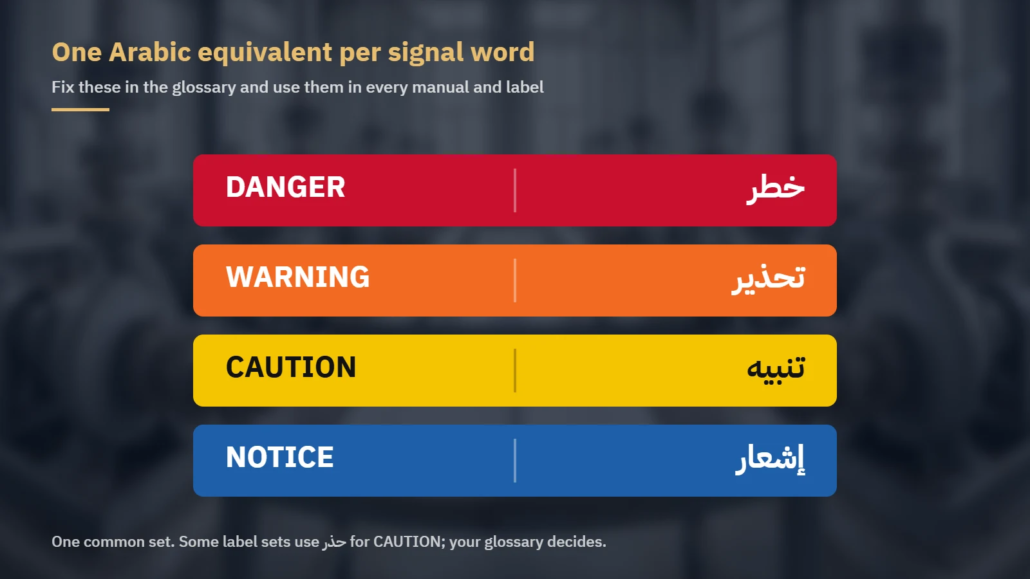
Some Arabic label sets use حذر for CAUTION instead; your glossary decides which one you use.
Keep NOTICE and NOTE distinct in Arabic if the source distinguishes them. Once approved, these words should not vary between chapters or between the manual and the product labels. A translated warning then reads, for example:
WARNING: Depressurize the line before removing the flange bolts.
تحذير: فرِّغ الضغط من خط الأنابيب قبل فك مسامير الشفة.
Market rules can also apply. The US International Trade Administration’s guide to Saudi Arabia notes that markings for warnings and safety instructions must be in Arabic or in Arabic and English, and that instruction manuals must be in Arabic or in both Arabic and English. Sector-specific technical regulations may add requirements. Your regulatory team should confirm what applies to your product and market.
4. Choose one convention for numbers, decimals and units
Arabic technical documents can use Western digits (0–9) or Arabic-Indic digits (٠–٩, Unicode U+0660 to U+0669). The decimal mark can be a period, a comma or the dedicated Arabic decimal separator (٫, U+066B). All of these appear in real documents, so decide on one convention and apply it throughout.
Keeping Western digits means values in the manual match drawings, data sheets and instrument displays. Whatever you choose, record it in the style guide together with decisions on:
- Unit symbols: keep SI symbols such as mm, bar and N·m in Latin script, or write Arabic abbreviations such as مم.
- Tolerances and ranges: how values such as 25 ± 0.05 mm and 10–16 bar are written and displayed.
- Dates and revision numbers: how “Rev. C, 2026-03” appears on title pages and in headers.
- Imperial values: whether the source’s dual units (psi and bar, °F and °C) are both kept.
A torque instruction, for instance, might read: “Tighten the bolts to 45 N·m in a cross pattern.” → “أحكِم ربط المسامير بعزم دوران 45 N·m بترتيب متقاطع.” The number and unit stay exactly as in the source; only the instruction changes.
5. Plan for right-to-left layout and mixed-direction text
Arabic runs right to left, but technical manuals are full of left-to-right content: part numbers, tag numbers, values with units and cross-references such as “see Section 4.2.1”. When these are embedded in Arabic sentences, the Unicode bidirectional algorithm can move punctuation and reverse the visual order of ranges if the text direction is not set correctly.
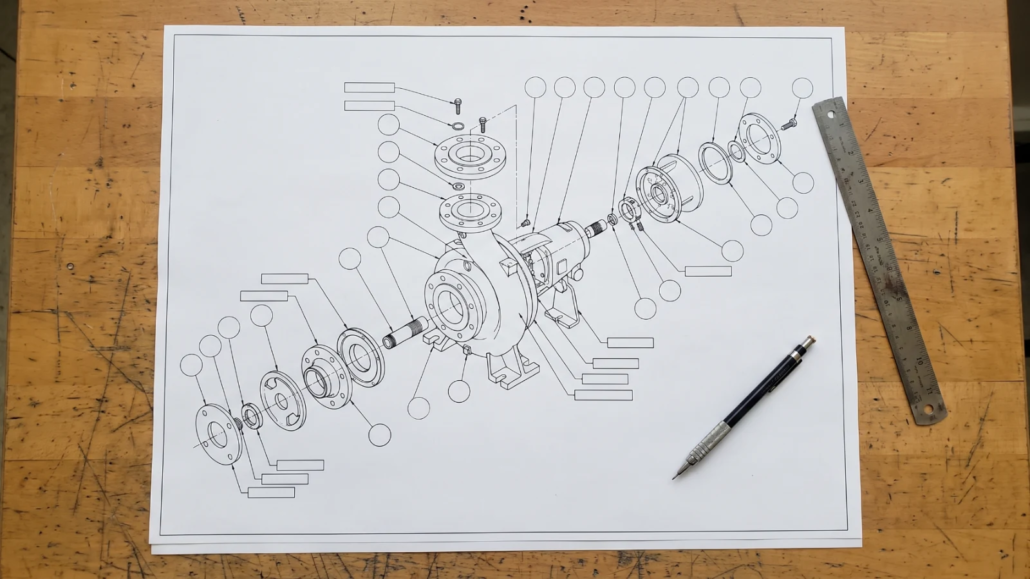
In structured authoring, direction is set at the source. The OASIS DITA specification provides the xml:lang attribute together with the dir attribute (values ltr, rtl, lro and rlo), and recommends specifying them on the highest-level element. In desktop publishing files, the layout has to be mirrored: page flow, table column order, numbered lists and callout positions all change. Exploded-view drawings with numbered callouts often need their text layers recreated so the Arabic labels fit and align correctly.
6. Send native source files, not only PDFs
A PDF is a delivery format, not a source. Wherever possible, send the files the manual was built from: InDesign or FrameMaker packages, DITA or other XML, Word files, and editable drawing text or exported callout lists. Native files let the Arabic version be delivered in the same format, keep your styles and structure, and simplify the next revision.
If part of the documentation only exists as scanned pages, for example legacy manuals for older equipment, ask for a legibility check before the project starts; Locstars checks scanned pages free of charge.
7. Write the source for translation
The clearer the English source, the more consistent the Arabic. ASD-STE100 Simplified Technical English, a controlled language originally developed for aircraft maintenance documentation, is one widely known reference. Its current version (Issue 9, January 2025) consists of 53 writing rules and a dictionary of approved words, each with one meaning and one part of speech.
Even without adopting STE formally, a few habits help: one instruction per sentence, the same verb for the same action, and no synonyms for the same component. Consistent source sentences also produce more translation memory matches, which lowers the cost of translating future revisions.
8. Plan review and revisions from the start
Decide who checks what. A second linguist can edit and proofread the Arabic, and your own engineers or Arabic-speaking field staff can review terminology in context. Agree on how comments come back, and who has the final say on terminology disputes.
Manuals are revised. Keeping the translation memory and glossary from the first project, and keeping the same translation team on the account, means Rev. B and Rev. C follow the terminology already approved for Rev. A.
Pre-project checklist: technical manual translation Arabic
| Decision | Who decides | Record it in |
|---|---|---|
| Scope: documents, drawings, labels, HMI text | Documentation owner | Project brief |
| Do-not-translate items | Engineering | Brief or source markup |
| Approved terminology | Engineering and translation team | Glossary |
| Safety signal words | Product safety or regulatory team | Glossary and style guide |
| Digits, decimals, units | Documentation owner | Style guide |
| RTL and bidirectional handling | DTP or structured authoring team | Style guide and templates |
| Native source files | Documentation owner | File transfer list |
| Review steps and approver | Project manager | Project plan |
Working with Locstars
Locstars translates technical documentation between Arabic and English, Chinese, French, Spanish, German, Turkish, Russian, Hindi, Japanese and Korean. Your manuals are handled by native-speaker translators who specialize in the subject, supported by a consistent term glossary and the same team kept on your account. You own the translation memory, and TM matches are charged at reduced rates on future revisions. Our DTP team recreates drawings and layouts for right-to-left Arabic, and files are delivered in the format you send. Editing and proofreading by a second linguist is available as a separate, optional step. Before a large project, we can translate a sample from your own document and run a free legibility check on scanned pages, and we work under your NDA. Learn more about our technical translation services or request a quote and receive it within one business day.
This article discusses translation and localization considerations only. Labeling, instruction and safety requirements vary by product and market; confirm them with your regulatory, product safety or legal team.
About the author: The Locstars technical translation team is made up of native-speaker, subject-specialist translators working with a DTP team that recreates drawings and right-to-left layouts, translating manuals, specifications and O&M documentation between Arabic and ten languages.

