
Common Errors in AI-Translated Arabic, With Examples

AI translation errors in Arabic are easy to miss: the Arabic reads fluently, the script renders, and a reader who doesn’t know Arabic sees nothing wrong, while the text says something the English never said. This guide sorts common Arabic machine translation mistakes into types, shows each in real output, and says what a reviewer looks for. Every Arabic example is real, copied from the human-evaluated outputs and references of a public 2025 evaluation or from published research; none was written for this article.
Where these examples come from
Most examples come from the WMT25 General Machine Translation shared task, run in 2025 by the annual Conference on Machine Translation (WMT). The systems included leading large language models and public online MT services, which the organizers anonymize. For English into Egyptian Arabic, bilingual native speakers marked the parts of each output they judged to be errors, rated each minor or major, and scored the segment. The results are in Kocmi et al. (2025), Findings of the WMT25 General Machine Translation Shared Task, which reports that “English→Arabic (Egyptian) and English→Italian proved to be the most challenging”. The annotated data is public on GitHub.
Some caveats. The texts are news, social media posts, fiction and video transcripts, not business documents. The target was Egyptian Arabic, so outputs in Modern Standard Arabic could be marked down as a whole; we rely on the words evaluators marked and on errors visible in the text, not on scores. The error types apply to MSA too (see our guide to MSA and dialect). The outputs show systems as submitted in 2025, not any current product. Each evaluated output was annotated twice, often by the same evaluator; “marked as a major error” means at least one annotation rated it major. The categories are our analysis, and we don’t name the systems. The human references come from the same data; they were evaluated too and are not flawless.
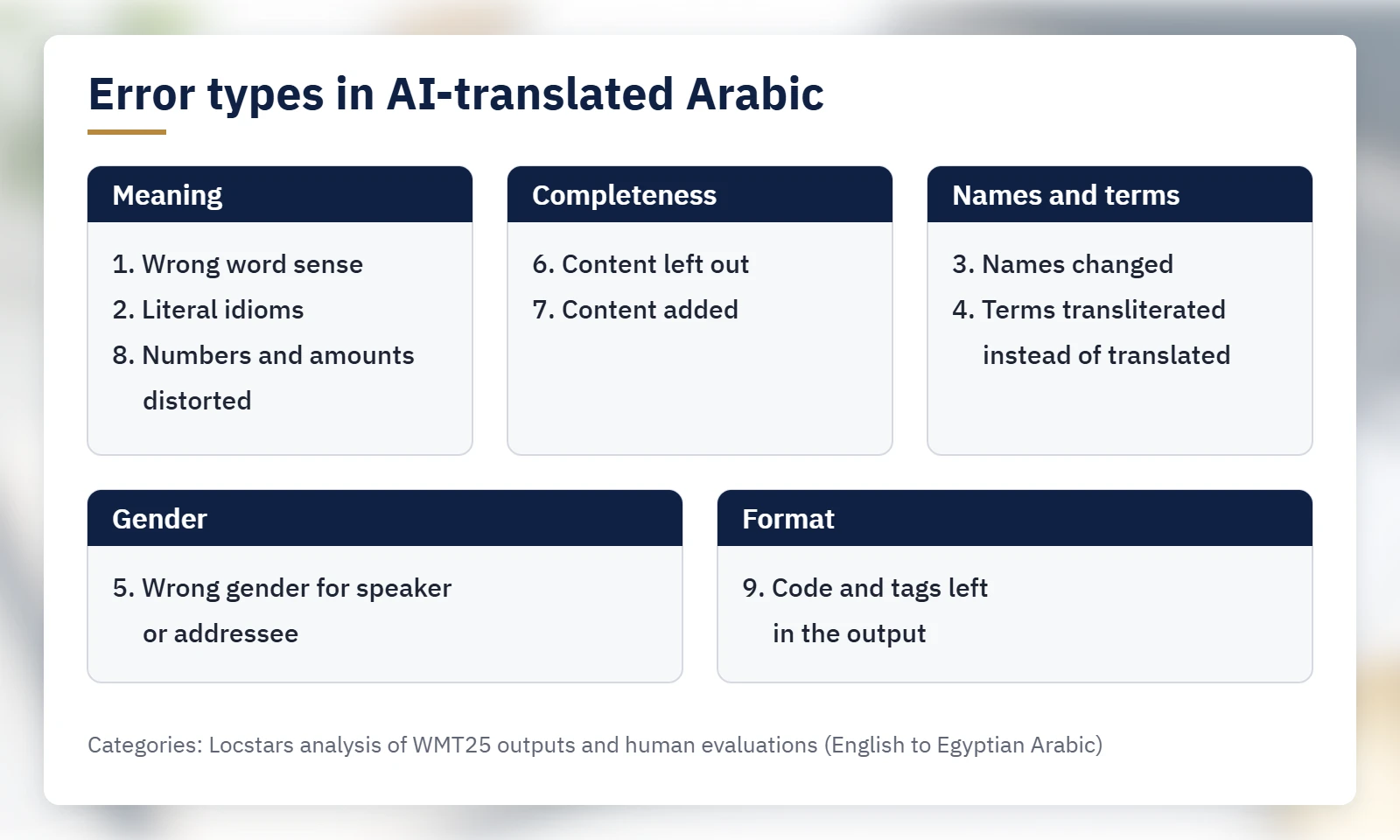
1. The wrong sense of a word
A newspaper headline about plastic straws, “A tale of two suckers”, uses “suckers” both for the straws and for people taken for fools; the second sense carries the joke. Two large language models kept only the straws. Nothing in the Arabic signals the loss: الشفاطات is a normal word for straws, and one output even used the correct dual. Both were marked as major errors. The reference kept “fools”, and both of its evaluators flagged that too: wordplay rarely has one right answer, but someone has to decide which meaning the Arabic keeps.
| English source | AI output | Human reference |
|---|---|---|
| “A tale of two suckers” | حكاية اتنين من الشفاطات (incorrect): “a tale of two of the straws” | قصة أحمقين: “a tale of two fools” |
| “A tale of two suckers” | حكاية ماصتين (incorrect): “a tale of two straws” | (same) |
What a reviewer looks for: source words with more than one meaning (in business text: term, party, release, issue, statement), checked against the sentence and the document. A glossary entry settles the sense once.
2. Idioms translated word for word
A word-for-word idiom produces Arabic that is grammatical and absurd. A social media post said “Just fell down a Doritos rabbit hole”, meaning the writer had become absorbed in the subject. One public online MT service translated the rabbit hole literally, and ten of the other 36 systems produced the same image. The human reference uses دوامة (“a whirlpool” or “spiral”), the same idea in an Arabic image.
| English source | AI output | Human reference |
|---|---|---|
| “Just fell down a Doritos rabbit hole” | لقد سقطت للتو في حفرة أرنب دوريتوس (incorrect): “I have just fallen into a Doritos rabbit’s hole” | أنا دخلت في دوامة من Doritos دلوقت: “I just got into a Doritos spiral” |
What a reviewer looks for: every idiom, metaphor and fixed expression, read for what it means; marketing and interface text are full of them. A literal idiom can survive back-translation (see our guide to checking AI-translated Arabic when you don’t read Arabic).
3. Names changed or read as ordinary words
Names should pass through unchanged or follow one agreed Arabic spelling. In a novel excerpt, one system turned the character Kyle into “Clay” and Declan into “Devan”. It also read “your Cup run with the Kings”, where the Kings is an ice hockey team, as ordinary nouns: “the King’s Cup with the two kings”. The passage was marked with major errors. In business content, the same failure can turn a brand or product name into a common noun.
| English source | AI output | Human reference |
|---|---|---|
| Kyle | كلاي (incorrect) | كايل |
| Declan | ديفان (incorrect) | ديكلان |
| “the Kings” (an ice hockey team) | الملكين (incorrect): “the two kings” | فريق كينغز: “the Kings team” |
What a reviewer looks for: a list of people, brands, products and features with their approved Arabic form (or a rule to keep them in Latin script), and a search for each across the file.
4. Terms transliterated instead of translated
A system may write the English sound in Arabic letters where Arabic has a term of its own. In a video transcript about levelling a floor, a large language model wrote “gauge rake”, a levelling tool, in Arabic letters; the reference uses مشط تسوية, literally a “levelling comb”. It was marked as a major error in one of its two annotations.
| English source | AI output | Human reference |
|---|---|---|
| “a gauge rake” | جايج رايك (incorrect) | مشط تسوية |
What a reviewer looks for: transliterations where Arabic has an established or descriptive equivalent, and English words left in the Arabic that are not names, codes or agreed brand terms.
5. The wrong gender for the speaker or the person addressed
Arabic marks gender on verbs, adjectives, pronouns and many nouns, for the person speaking and the person addressed. English “I”, “you” and “sweetheart” carry no gender, so a system has to infer it from the context. In a novel excerpt, a director of admissions greets a new arrival: “Excuse me, sweetheart! New arrival?” The passage calls him “he”, and he answers “I’m Declan”. One model addressed him in the feminine throughout the line, and an evaluator marked these words, with most of the passage, as major errors; the reference uses the masculine جديد (“new”).
| English source | AI output | Human reference |
|---|---|---|
| “Excuse me, sweetheart! New arrival?” (said to Declan, “he” in the passage) | عفوًا يا عزيزتي! هل أنتِ وافدة جديدة؟ (incorrect): feminine, “Excuse me, my dear [f.]! Are you [f.] a new arrival [f.]?” | أنت لسه جديد هنا: masculine, “you’re new [m.] here” |
Alhafni, Habash and Bouamor (2022) give the example “I am a doctor and you are a nurse” and write that gender-unaware machine translation from English often results in أنا طبيب وأنت ممرضة (gender-unaware default), “I am a [male] doctor and you are a [female] nurse”, which they call inappropriate for female doctors and male nurses.
What a reviewer looks for: who is speaking and who is addressed, settled in the brief, and every gendered verb, adjective and pronoun checked against the source context. Our guide to checking AI-translated Arabic when you don’t read Arabic covers the form-of-address decision.
6. Content left out
A system may summarize a long passage instead of translating all of it. A 647-character transcript from the same flooring video came back from one system as 195 characters: it keeps the opening and the end, drops the middle and repeats هنا كمان (“here too”). Both annotations marked content as missing.
| English source | AI output | Human reference |
|---|---|---|
| Includes “that’s two bags right there, so we’ll dump that out like that” | …نشوف دي كمان، هنا في الناحية دي، هنا في الناحية دي، هنا كمان، هنا كمان… (incorrect): an extract; the whole output never mentions the bags | في كيسين هنا، هافرغهم كده: “There are two bags here, I’ll empty them like this” |
What a reviewer looks for: a segment-by-segment comparison with the source. Length checks catch large gaps; a dropped “not” or condition needs bilingual reading.
7. Content added: alternatives and notes
A system may add explanations, notes or a choice of translations: useful in a chat, wrong in a deliverable. For the same “rabbit hole” post, one system returned slash-separated alternatives and then a second translation in brackets, introduced by أو: (“or:”).
| English source | AI output | Human reference |
|---|---|---|
| “Just fell down a Doritos rabbit hole” | لقد انغمستُ للتو في عالم "دوريتوس" المثير للاهتمام/المدهش. (أو: لقد اكتشفتُ للتو أشياءً مدهشة/ممتعة عن "دوريتوس") (incorrect): two versions, with slash-separated word choices | (as in section 2) |
What a reviewer looks for: slashes, brackets, notes and “or” where the source has none, and segments much longer than their source.
8. Numbers and amounts distorted
The digits can be copied correctly while the operation, the unit or the direction breaks. In a recorded conversation about a household budget, the speaker says “$2,600 minus $1,575.76”. A public online MT service rendered it as “we will subtract $2,600 from $1,575.76”, reversing the calculation. It was marked as a major error.
| English source | AI output | Human reference |
|---|---|---|
| “We’re going to do $2 ,600 minus $1 ,575 .76” (as transcribed) | سنطرح 2,600 دولارًا من 1,575.76 دولارًا (incorrect): “we will subtract $2,600 from $1,575.76” | هنخصم 1,575.76 دولار من 2,600 دولار: “we’ll deduct $1,575.76 from $2,600” |
What a reviewer looks for: every number with its unit, currency and relation (before or after, at least or at most, which figure is subtracted from which). In invoices, contracts and specifications, these errors can cost money.
9. Code and tags left in the output
In the outputs collected from one public online MT service, quotation marks appear as the HTML code " in 92 of its 199 human-evaluated outputs. Leaks like this can come from how a tool is connected, so test the whole pipeline. Another system ended a novel passage with the stray language tag “en-ja”. Both examples were marked as major errors.
| English source | AI output | Human reference |
|---|---|---|
| “They are all wauwau insteaf [sic] of Bark Bark” | حتى الكلاب هنا تتكلم الألمانية! جميعها تنطق "واوواو" بدلًا من "بارك بارك". (incorrect): HTML code instead of quotation marks | "ڤاو ڤاو" بدل "هو هو": ‘vau vau’ instead of ‘woof woof’ |
What a reviewer looks for: automated QA for tags, entities, placeholders and punctuation, then a look at the Arabic where it will appear. Our guide to plurals, RTL and bidi in Arabic apps covers the display side.
Checklist: catching AI translation errors in Arabic
- Before translating, decide MSA or dialect, the market, and the gender of the speaker and the readers.
- Provide a glossary of names, brands and terms with approved Arabic forms.
- Flag ambiguous words, wordplay and idioms in the source, and decide what the Arabic keeps.
- Compare the Arabic with the source, segment by segment, for omissions and additions such as notes and alternatives.
- Check every number with its unit, currency and relation.
- Search for transliterated terms and stray English words.
- Check that the Arabic keeps to one variety, MSA or the agreed dialect, throughout.
- Run automated QA for tags, HTML entities, placeholders and punctuation, then view the Arabic where it will be published, in a right-to-left layout.
- Send customer-facing content for bilingual review by a native-speaker linguist; for legal, medical and patent documents, marketing and games, start from human-led translation.
Working with Locstars
If you already have AI-translated Arabic, you can send up to 300 words of it for a free AI translation check on our AI translation review page. You get a short summary of the main issue types, with examples, the same business day, not a corrected file or a score. It’s one check per company, a company email is required, and we can sign your NDA before the check. For the whole file, ask for a full review and correction by a specialist linguist, with terminology aligned to your glossary (we can create one if you don’t have it) and delivery in your file format. For new internal, knowledge-base or eLearning content, see our AI-assisted translation with post-editing, where a native-speaker specialist linguist post-edits every segment; other translation is human-led, and you can choose no AI. To scope a project, request a quote.
This article is general information. Examples are quoted from public research data and a published paper to illustrate error types; they do not assess any product, AI tool or vendor, or show how any current product performs. Names inside quoted examples belong to their respective owners; Locstars is not affiliated with them.
About the author: The Locstars AI & Technology team combines AI-assisted workflows with native-speaker specialist linguists who review and post-edit Arabic for companies.
