
Preparing Company Documents for Arabic Translation: A Gulf Checklist

When a company registers a branch, opens a subsidiary or bids for a public contract in the Gulf, the same handful of corporate documents tends to travel with it: the commercial registration extract, the articles of association, board and shareholder resolutions, company profiles and the tender response itself. Many problems that slow these files down are inconsistencies already in the source package: a company name spelled three ways, a figure that does not match the amount in words, a date that can be read two ways.
In some settings, the Arabic text carries real weight. Saudi Arabia’s Government Tenders and Procurement Law, for example, states that contracts, their annexes and related documents are drafted in Arabic, and that where another language is also used, Arabic is the language of interpretation and execution. The new version of the law published in September 2026 keeps the same rule. That is a good reason to prepare the source files carefully before translation starts. This checklist covers what legal, bid and corporate secretarial teams can fix before translation, and what to agree with the translators up front.
1. Fix one Arabic company name before anything else
A frequent problem in a multi-document package is the company name itself. An invented foreign name such as “Zelbrook Engineering” can be transliterated into Arabic in several defensible ways: زيلبروك, زلبروك or زيل بروك. If the registration extract, the resolution and the bid letter each use a different one, the receiving body sees three names and may ask whether they refer to the same entity.
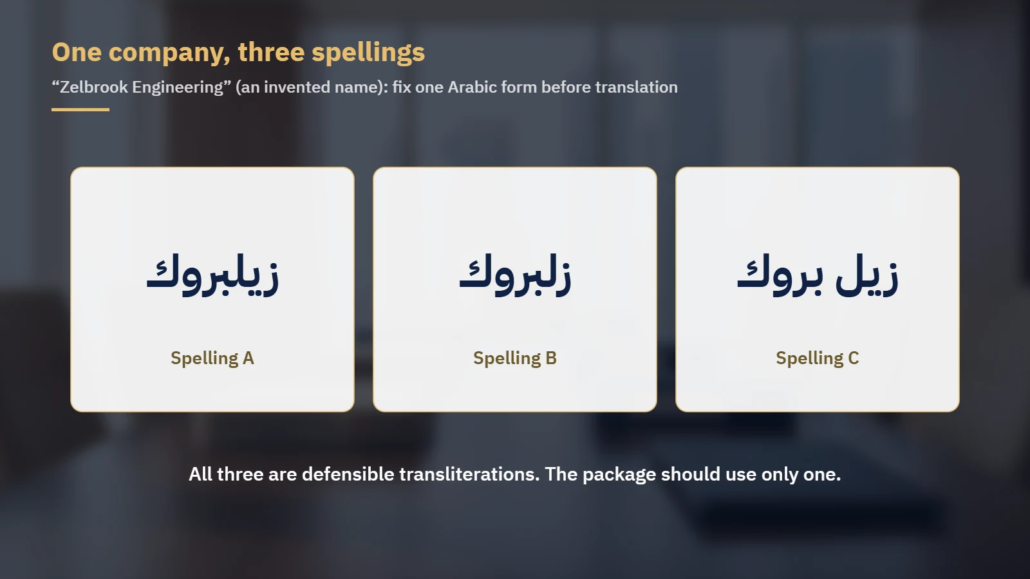
Before sending files, decide the following and give the decisions to the translators as instructions, not as preferences:
- Whether the entity already has a registered Arabic name. If it does, that name should be reproduced exactly, including word order and spacing.
- Which names appear in the package: parent company, subsidiary, branch, joint venture partner, and any former names. Each needs its own fixed Arabic form.
- Whether the legal-form suffix (GmbH, S.A., Ltd, Co., Ltd.) is translated, transliterated or kept in Latin script. Your counsel or the registering body decides this; the translators then apply it consistently.
- For Chinese companies, whether the Arabic follows the registered English name or a Pinyin reading of the Chinese name. Mixing the two causes mismatches.
The same applies in reverse: in Arabic-to-English work, محمد may appear as Mohammed, Muhammad or Mohamed. Use the spelling in the person’s passport or corporate records, consistently.
2. Build a short register of people, titles and authorities
A one-page register of names, titles and bodies removes guesswork:
- People: full names of directors, managers, shareholders and authorized representatives, in the spelling used in their identity documents.
- Titles: Chief Executive Officer (الرئيس التنفيذي), Chairman of the Board (رئيس مجلس الإدارة), General Manager (المدير العام). For titles with no direct equivalent, describe the role.
- Authorities and bodies: the exact names of the registries, ministries or procuring entities involved, so their established Arabic names are used rather than literal renderings.
3. Agree the key corporate and tender terms
The correct Arabic term can depend on the entity type and the country of filing. The renderings below are a glossary starting point, not a substitute for your counsel’s decision.
| English term | Common Arabic rendering | What to confirm |
|---|---|---|
| Limited liability company | شركة ذات مسؤولية محدودة | The exact legal form in the target jurisdiction |
| Joint stock company | شركة مساهمة | Whether a specific subtype is registered |
| Branch of a foreign company | فرع شركة أجنبية | How the branch name is registered in the host country |
| Commercial registration | السجل التجاري | The number format used on the extract |
| Articles of association | عقد التأسيس / النظام الأساسي | Which term fits the entity type and jurisdiction |
| Board resolution | قرار مجلس الإدارة | Whether it is a board or shareholders’ resolution |
| Share capital | رأس المال | Authorized vs. paid-up amounts |
| Bill of quantities | جدول الكميات | Whether the tender file supplies its own Arabic headings |
| Tender | منافسة (Saudi usage); مناقصة (common elsewhere) | The wording used in the tender documents themselves |
| Bid / offer | عرض | The wording used in the tender documents themselves |
For tenders, the strongest source of terminology is the procuring entity’s own Arabic documents. In Saudi Arabia the tender booklet is typically called كراسة الشروط والمواصفات; if you received it in Arabic, send it with your files so the translators can mirror its headings, item names and defined terms in your response. The agreed terms then apply across the whole package.
4. Reconcile numbers, amounts in words and dates
Figures are where a small inconsistency can matter most. Saudi Arabia’s Executive Regulations of the Government Tenders and Procurement Law require bid prices in the bills of quantities to be written in figures and in words, and state that if the two differ, the price in words prevails; check the tender documents for the rule that applies to your bid. The translation can only be as consistent as the source, so check before sending:
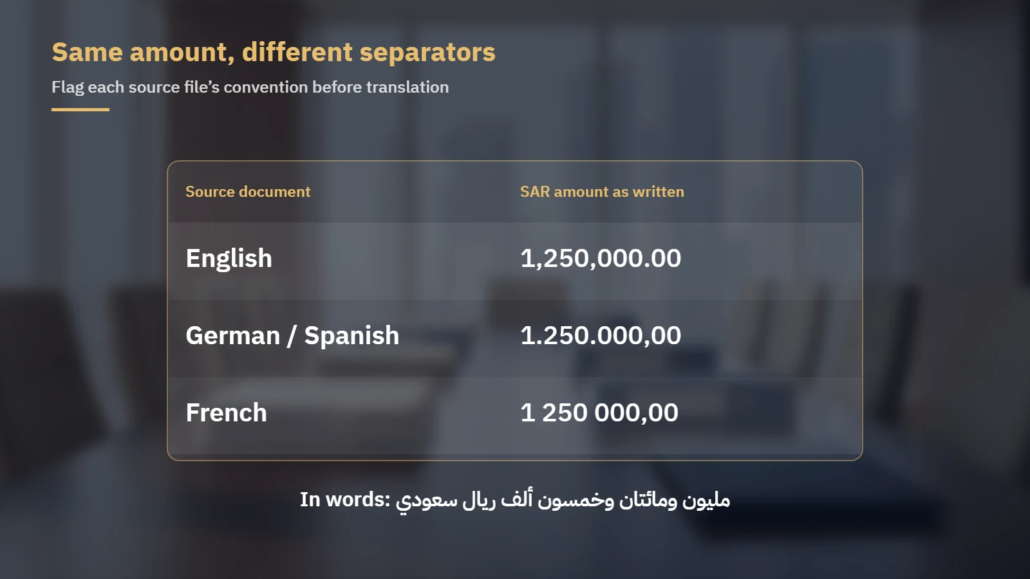
- Figures vs. words: every amount written in both forms should match in the source. For example, SAR 1,250,000 corresponds to مليون ومائتان وخمسون ألف ريال سعودي. If the English says “one million two hundred thousand”, the discrepancy will be carried into the Arabic.
- Decimal and thousands separators: German and Spanish source documents commonly write 1.250.000,00, and French documents 1 250 000,00, where English writes 1,250,000.00. Flag which convention each source file uses, especially in financial annexes.
- Digits: ask the receiving body whether it expects Western digits (0–9) or Eastern Arabic digits (٠–٩) in the Arabic version, and keep one style throughout.
- Dates: 03/04/2026 can mean 3 April or 4 March. Write dates with the month in words where possible. Some Gulf documents are dated in the Hijri calendar, sometimes alongside the Gregorian date; tell the translators whether both should be kept as they appear.
- Reference numbers: registration numbers, tender reference numbers and capital figures should be copied, not retyped, into any cover letter, so there is one source of truth.
5. Prepare the layout, not just the text
Arabic runs right to left, and numbered clauses, shareholder tables, bills of quantities and mixed Latin-Arabic strings all behave differently when direction flips. A few steps help:
- Send editable source files (Word, Excel, InDesign) where they exist; a native Excel bill of quantities is easier to reproduce accurately than a scan.
- Where only a scan exists, send the clearest copy and have it checked for legibility first. Resolve faint or cropped figures with the issuer.
- Agree how logos, graphics and handwritten notes will be represented.
- Specify the delivery format: mirrored Arabic layout, bilingual side-by-side, or the procuring entity’s template.
6. Confirm scope and form with the receiving body
Not every document in a data room needs to be in Arabic, and requirements vary between registries, free zones and procuring entities. Before commissioning the work, ask the receiving body which documents it needs in Arabic, whether it wants full or partial translations, and in what format. Confirm the required form with the body receiving the document; your counsel or advisers are best placed to interpret those requirements for your specific filing.
Send the whole package at once where possible. Translating the registration extract this week and the resolutions next month, with different people, is how company names and titles start to drift.
7. Pre-submission checklist
- One Arabic company name fixed for each entity, including legal-form suffixes.
- Register of people, titles and authorities shared with the translators.
- Glossary of corporate and tender terms agreed, aligned with the tender booklet where one exists.
- Figures and amounts in words reconciled in every source document.
- Separator, digit and date conventions confirmed.
- Editable source files or the clearest available scans supplied.
- Delivery format and layout agreed (mirrored, bilingual or client template).
- Scope and required form confirmed with the receiving body.
- Optional second-linguist editing and proofreading decided and scheduled before the submission deadline.
Working with Locstars
Locstars translates company documents between Arabic and English, Chinese, French, Spanish, German, Turkish, Russian, Hindi, Japanese and Korean, using native-speaker translators who specialize in corporate and tender documents. We build a consistent term glossary for each account and keep the same team on it, so names and terms stay aligned from the registration extract to the bid. Our DTP team recreates tables and layouts in right-to-left Arabic, and files are delivered in the format you send. We offer a free legibility check on scanned documents, a sample translation from your own document before a large project, and editing and proofreading by a second linguist as a separate, optional step. We work under your NDA and delete files on request. Learn more about our company document translation services, or request a quote and receive one within one business day.
This article covers translation and document-preparation considerations only and is not legal or regulatory advice. Requirements differ by country, registry and procuring entity; confirm them with your counsel and with the body receiving the documents.
About the author: The Locstars corporate document team is made up of native-speaker subject-specialist translators who handle company registration, governance and tender documents between Arabic and ten languages, supported by the company’s DTP team for right-to-left layouts.

